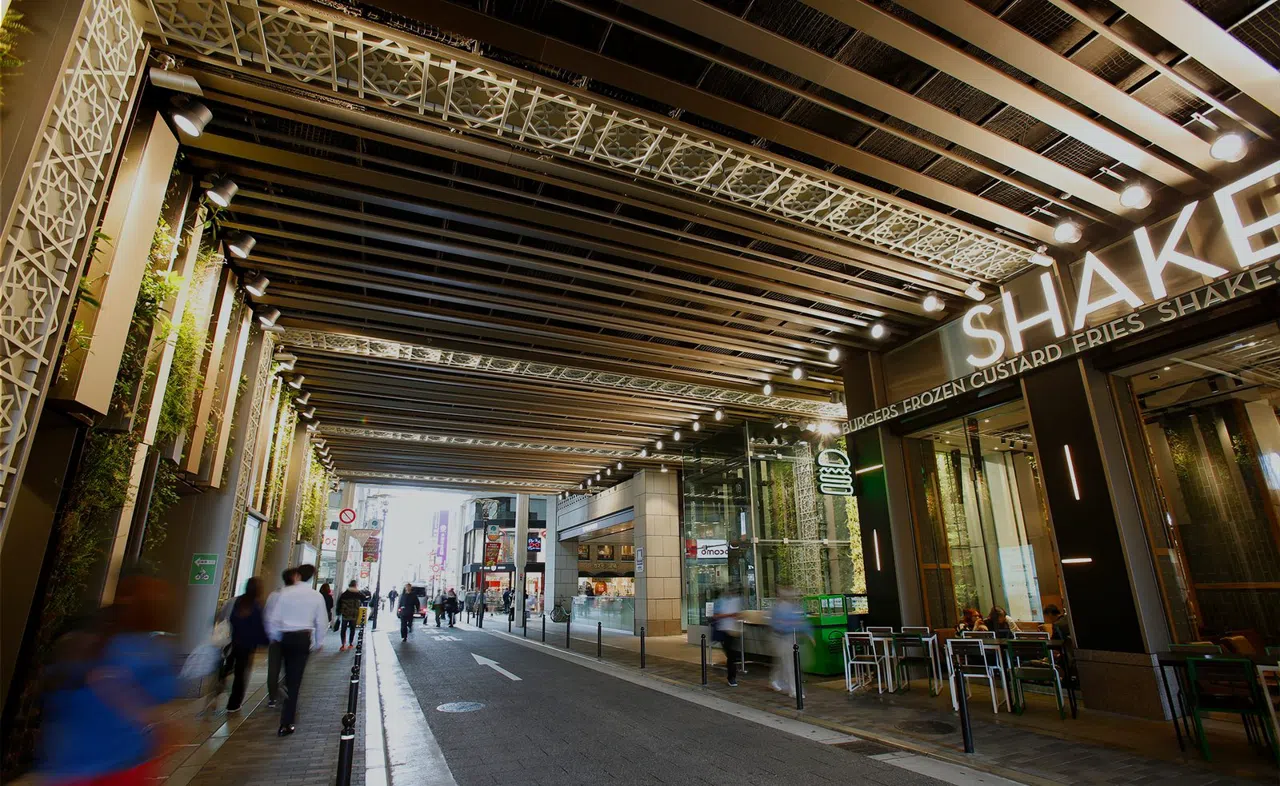

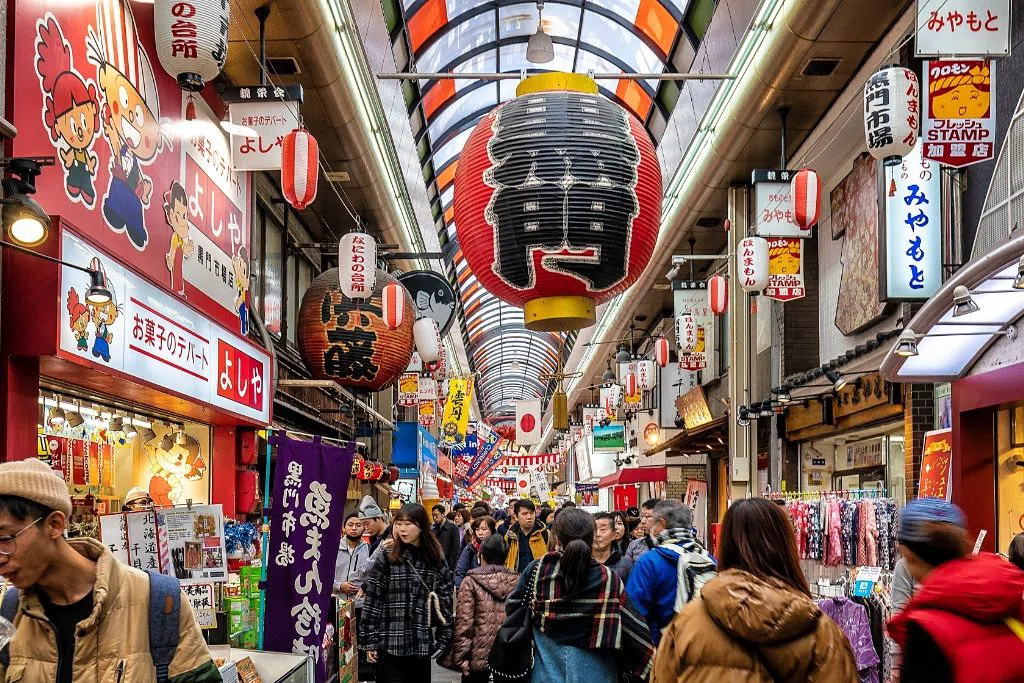
The arcade roof turns Shinsaibashi into a weatherproof tunnel of noise, and the noise changes by the hour. At nine in the morning it is shutters rolling up and delivery trolleys squeaking over tile, with enough room to walk four abreast; by six in the evening the same eight blocks are one slow river of people and you move at the pace the crowd allows. Learning the difference between those two versions of the street is the whole trick, and it takes about a day.
The eight blocks that hold the district together
Shinsaibashi-suji Shopping Street (Chuo ward, the spine of Osaka's Minami) is the attraction itself, not a stop on the way to one. Roughly 180 shops run over eight blocks, clean from Nagahori in the north down to Dotonbori in the south, under a continuous covered roof. It costs nothing to walk, and the price range inside is absurdly wide: ¥100 drugstore items in one doorway, four-figure sums two doors down.
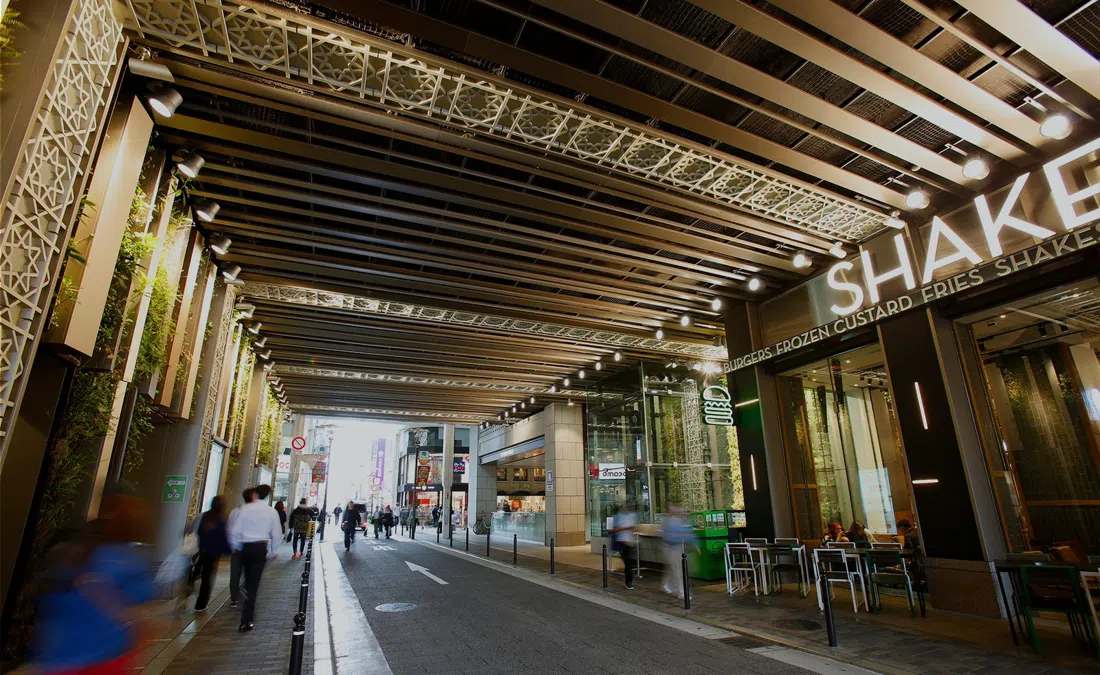
The roof is the reason this street works as the backbone of any Osaka day. Rain does not cancel it, heat does not flatten it, and you can string a whole afternoon together without ever consulting a forecast. The cost is congestion. In the 18:00 crush the arcade thins down to something close to single file, and anyone who has arranged to meet friends "in the arcade" has arranged to lose them. Pick a side street with a recognisable doorway instead. The cross-lanes are quieter within ten paces and you can actually stand still in them.
Walking the full length without stopping takes about twenty minutes. Walking it properly takes two to three hours, and that is before you step off it.
Three buildings on the arcade worth going inside
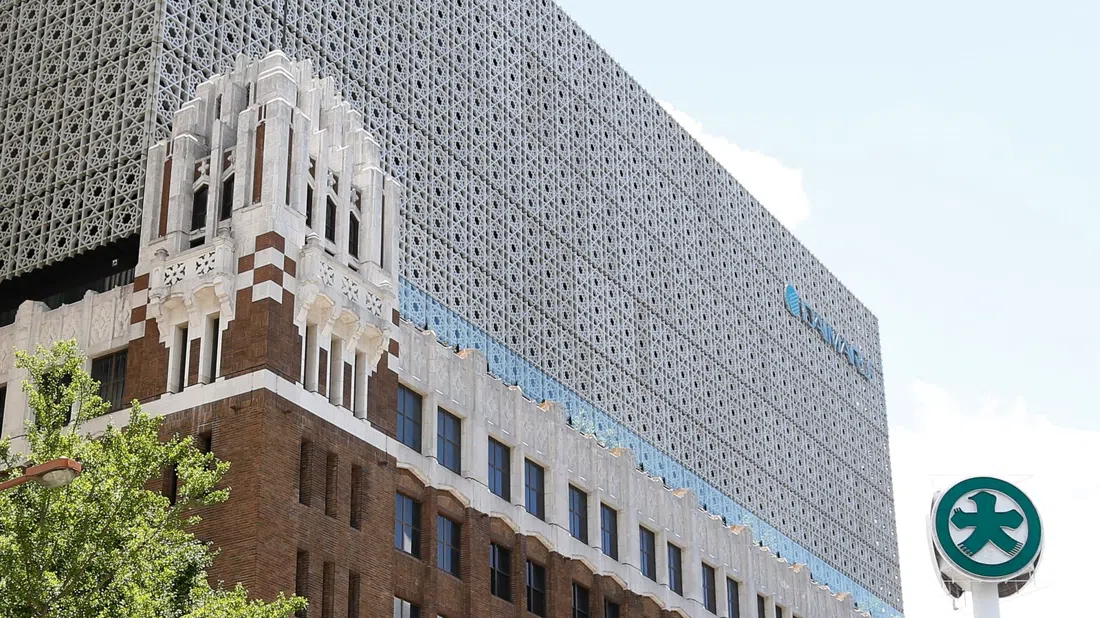
Daimaru Shinsaibashi Main Building (mid-arcade, Shinsaibashi) is the single best free "look at this building" stop on the street. The 1933 interior by William Merrell Vories was rebuilt over four years, and roughly two-thirds of the original interior parts were reused for the 2019 reopening, so it is neither a replica nor a preserved museum piece but something in between. Entry is free, the food hall will feed you for ¥500-2,000, and there is a baggage desk and a tax-free counter if you are shopping seriously. The counter queues at midday; go early or go late.
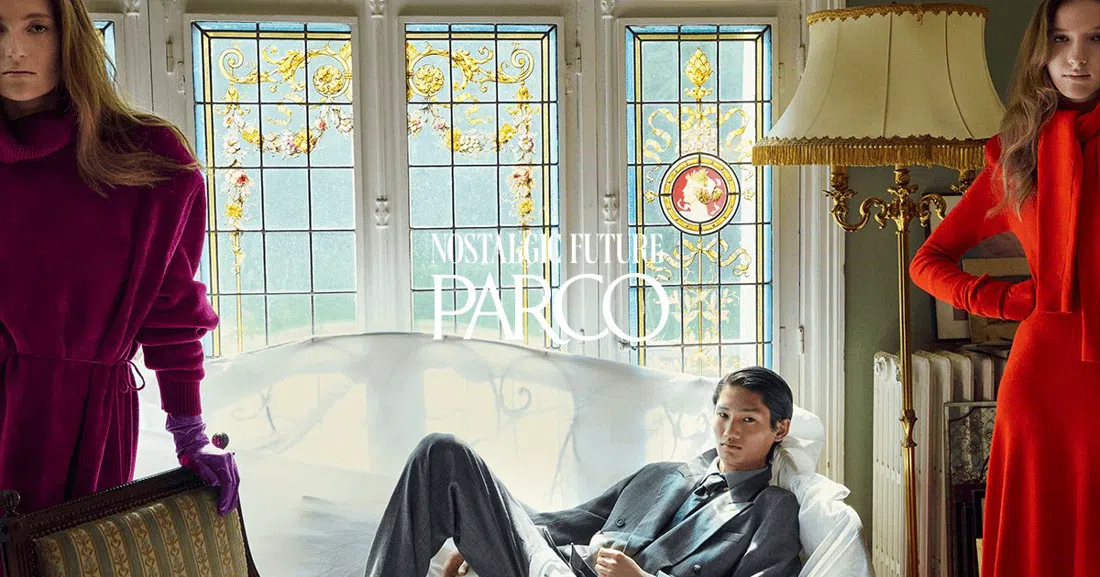
Shinsaibashi PARCO (attached to Daimaru, mid-arcade) is the one modern mall on this street that earns a deliberate stop rather than a wander-through. The character and game floors carry Capcom Store Osaka, the Disney Store and Ghibli goods, and a Sega store is slated to join them in October 2026. The basement neon alley is the part people remember: a food street of small counters, ¥800-2,500 a dish, deliberately styled like an old back lane. Those counters seat small groups, not large ones. Four people will get seated together; a dozen will be split across two or three bars whether they like it or not.
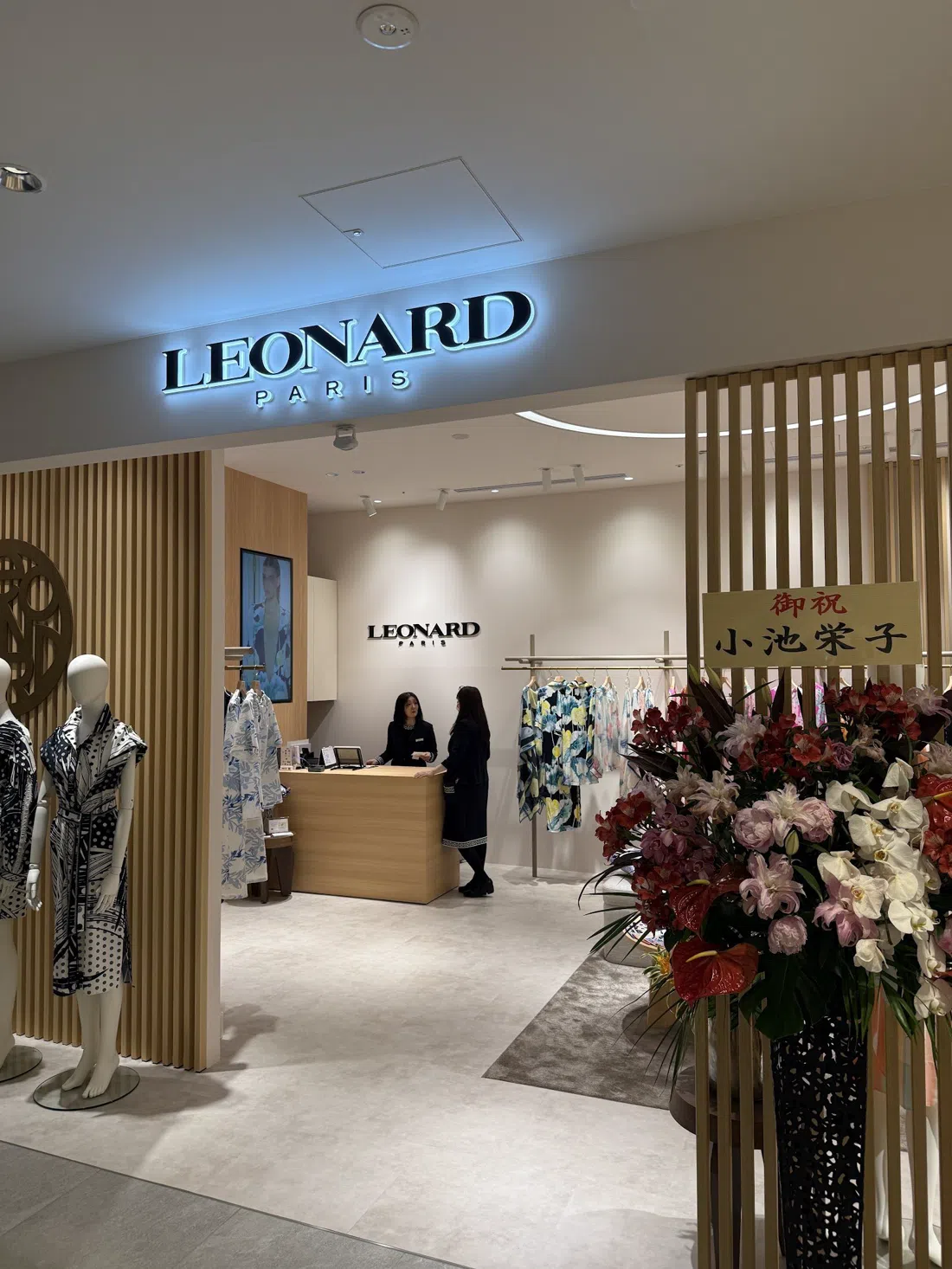
QUARTZ Shinsaibashi (north end, on Midosuji) opened in April 2026 and is the newest thing on the boulevard. Diesel, Lacoste, Mammut, Descente and a North Face footwear concept are already trading, with Bulgari, Cartier, Chaumet and Fendi phasing in through the autumn. You do not have to want any of that to use the building: the lobby is wide, the basement patisseries run about ¥600-1,500, and it is the most civilised place in the area to regroup when half your party has drifted.
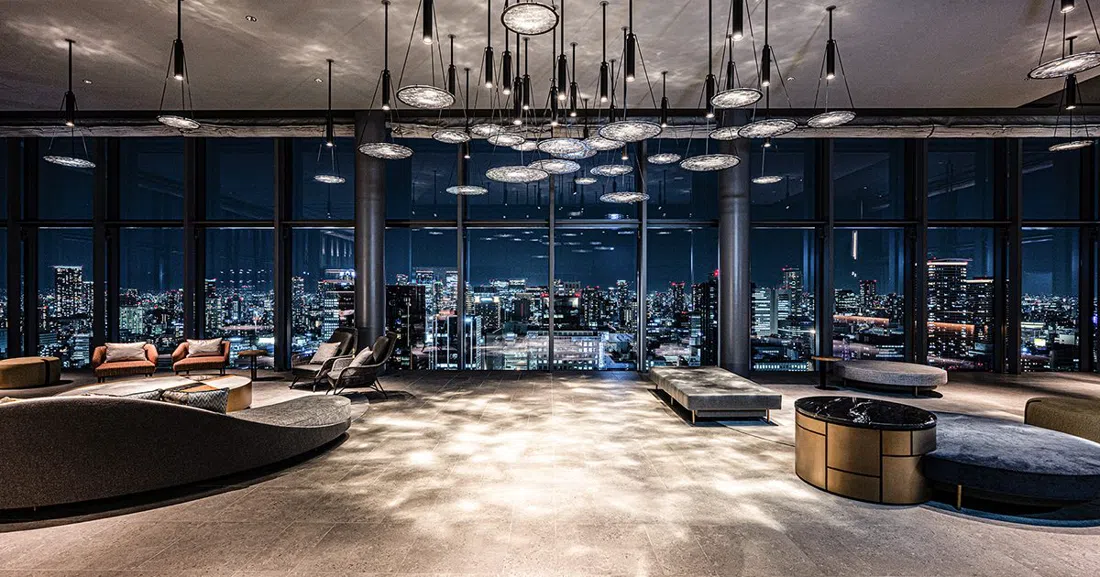
PEAKS rooftop bar, The Gate Hotel Osaka by Hulic (on top of QUARTZ, north Shinsaibashi) opened in June 2026 and is currently the only proper elevated view directly over Shinsaibashi rather than from a tower somewhere across the city. Drinks run about ¥1,500-2,500. Seating is genuinely limited, so book ahead, keep the group small, and check the hours the same week you go, because the bar is new enough that service times still move.
Step one block west when the crowd gets heavy
Midosuji Boulevard (one block west of the arcade, running north-south) is the relief valve. It is the same district in a completely different register: ginkgo trees, wide pavements, air and space instead of roof and crowd noise. Luxury flagships line it, but the reason to walk it has nothing to do with shopping. It is the one place near Shinsaibashi where a group can walk abreast, stop for a photo and not be an obstruction.
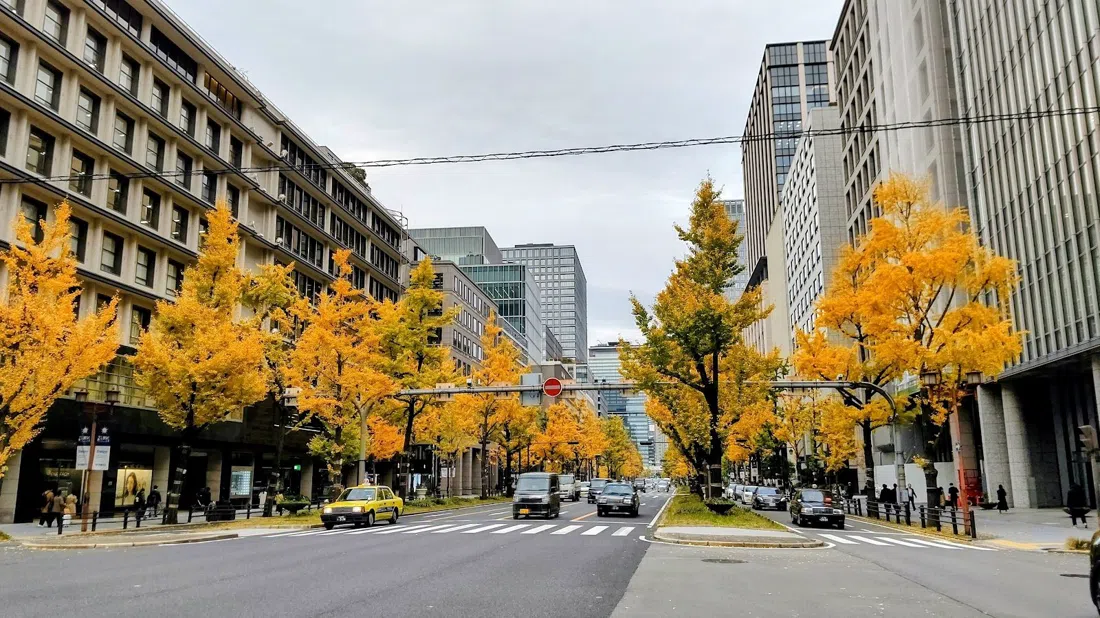
The practical move is to treat the arcade and the boulevard as two lanes of the same route. Walk south under the roof, hop west when the density gets unpleasant, walk a few blocks in the open, hop back. Locals do this without thinking about it.
Amerikamura is the other half of the story
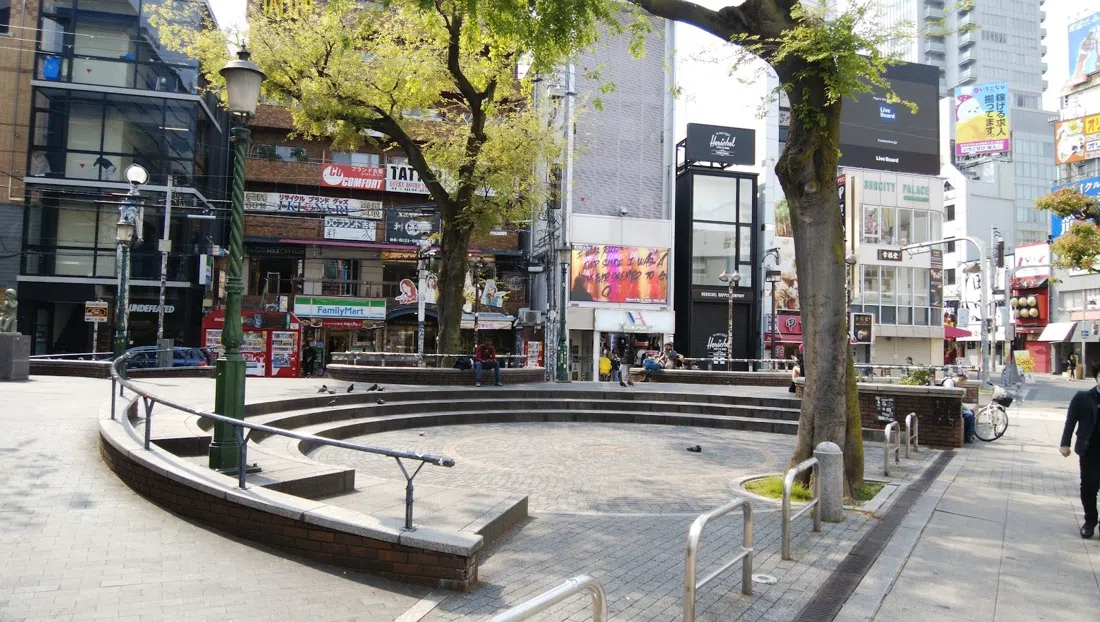
Amerikamura and Mitsu Park (Triangle Park) (immediately west of the arcade, Chuo ward) is the scruffy counterweight to Midosuji, and it belongs in any honest account of this area precisely because it is not polished. Second-hand clothing, skate shops, young comedians doing free manzai sets on the steps of the plaza, takoyaki at ¥500-800. The plaza itself is open public space and handles a group fine. The vintage shops around it do not. Most are single small rooms, so send people in two or three at a time and let the rest wait on the steps.
Shinsaibashi BIG STEP (Amerikamura) is the district's reliable rainy-afternoon answer. Free to enter, with over a thousand capsule machines and crane games across the basement floors, a pinball parlour, a cinema, the BIGCAT live house and a floor of vintage clothing. Gachapon runs ¥300-600 a turn, which is the cheapest entertainment in Minami and the easiest way to keep teenagers occupied for an hour. A group of any size can absorb itself here without anyone needing to queue.
Ten minutes west for coffee and quiet
Orange Street (Tachibana-dori), Minami-Horie (ten minutes west of the arcade) is the obvious escape from the crowd, and the one part of this walk that rewards going early. Interiors shops, roasters and select stores, BIOTOP and Timeless Comfort among them, with coffee at ¥500-900 and cafés open from 08:00. That opening time is the useful fact: a slow breakfast here and a 10:00 arrival on the arcade puts you an hour ahead of the day.
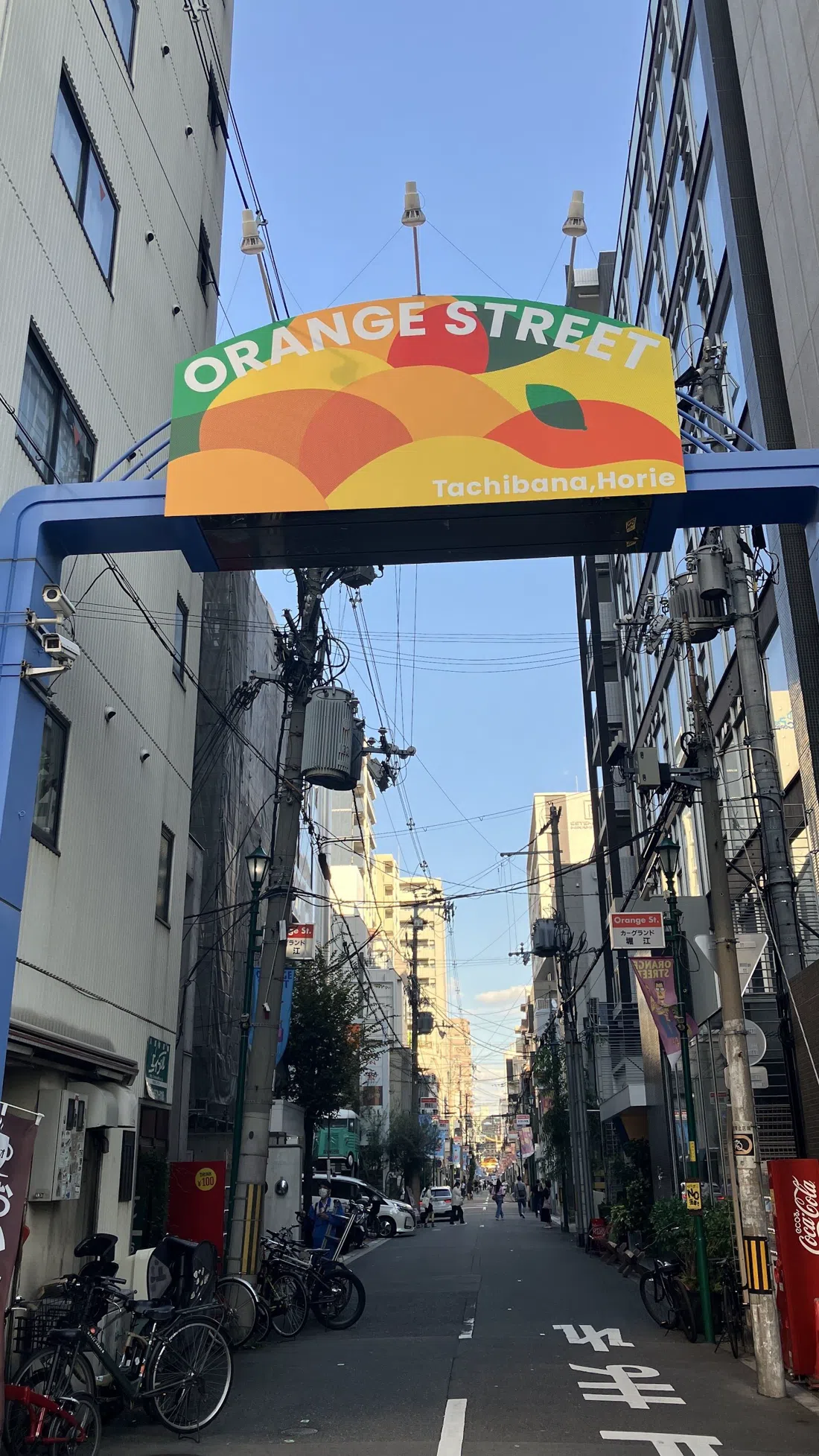
The shops and cafés are small. Two to four people is the right size; a larger group will not fit in any one room and will end up standing on the pavement.
Where the arcade runs out and Dotonbori begins
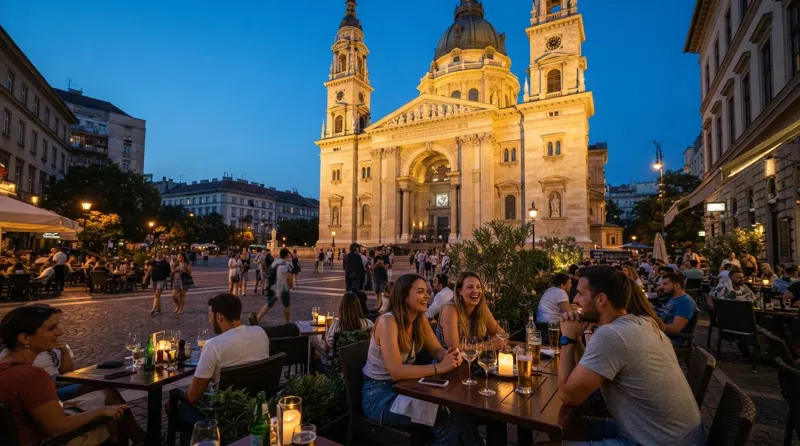
Ebisubashi Bridge and the Glico Sign (south end of the arcade, Dotonbori) is five minutes off the end of the street and is the photo everyone comes for. It is also the single most congested spot in Minami, and standing on the bridge to take it is the worst available option. Shoot head-on from the Tonbori riverwalk on the north bank instead, and go either early in the morning or after about 20:00, when the sign is lit and the wall of people has thinned. Groups should not attempt the bridge itself at all.
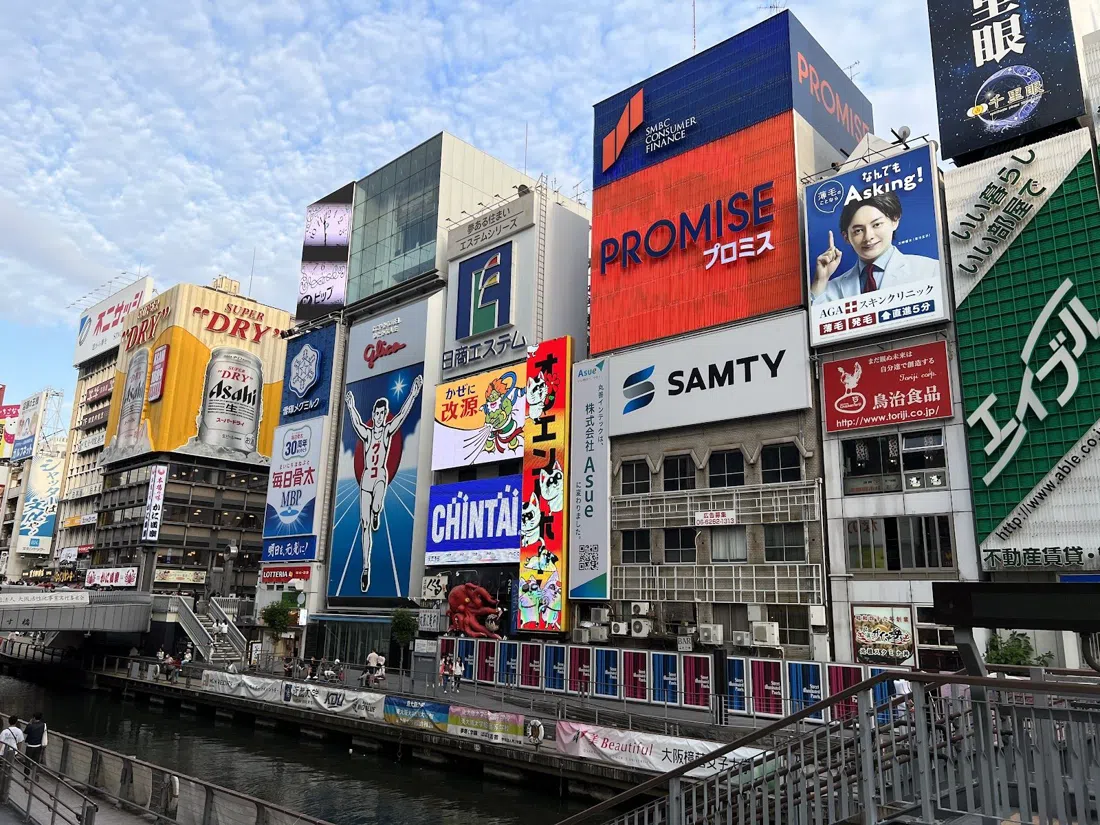
Tombori River Cruise (Ipponmatsu Shipping) (Tazaemonbashi Pier, beside Don Quijote, Dotonbori) is the fix for the same problem. Twenty minutes on the canal, departures every 30 minutes from 11:00 to 21:00 daily, ¥2,000 for adults, ¥1,000 for students and ¥500 for children. The patter is in Japanese with an English sheet handed out, which is fine because the point is the view: you see the Dotonbori signage from below and from the water rather than shoulder to shoulder on a bridge. It takes groups well, though book ahead for more than a handful of people.
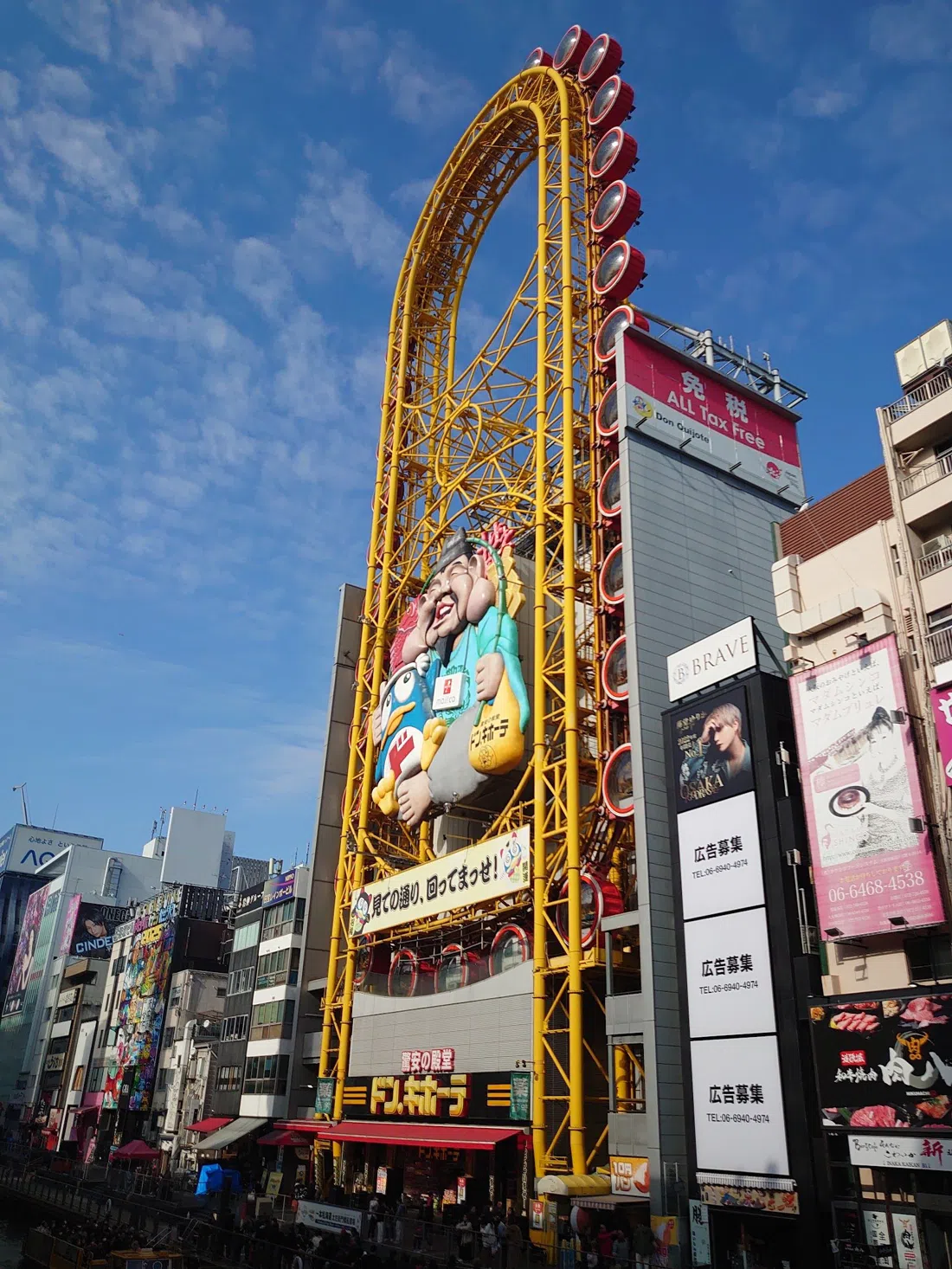
Dotonbori Ferris Wheel 'Ebisu Tower' (on the Don Quijote building, Dotonbori) is fifteen minutes and ¥1,000, cash only at the booth. Warn people before you walk over, because a card-only traveller gets turned away. It runs on an unusual oval track straight up the canal frontage rather than a conventional circle. Pods hold small numbers, so a group rides in shifts. It starts at 13:00 on Tuesdays for maintenance, and it is worth checking the day's operation before you build a plan around it.
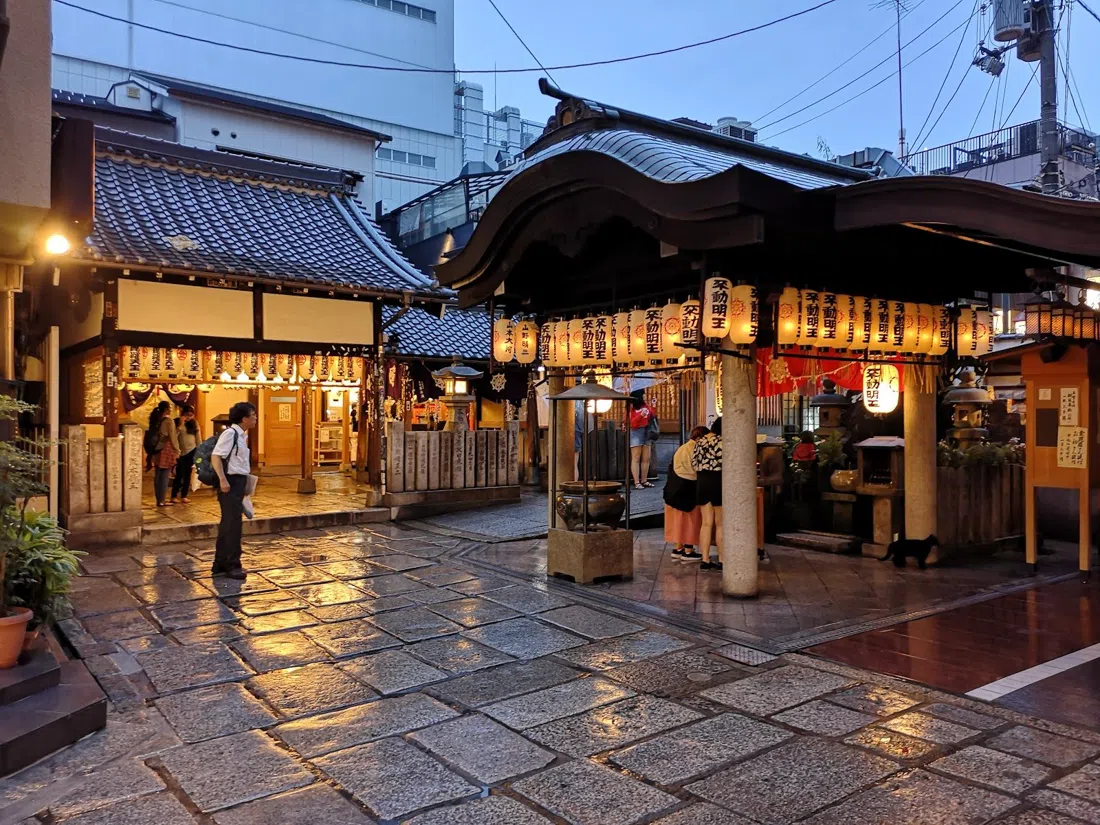
Hozenji Yokocho and Hozen-ji (Mizukake Fudo) (three minutes from the arcade, Namba side) is the sharpest contrast in the district and the reason to keep walking past the bridge. A stone-paved alley barely two metres wide, lit by lanterns from about 19:00, with counter-sized restaurants at ¥3,000-8,000 a head. The temple courtyard with its moss-covered statue is accessible around the clock and costs nothing. Small groups only, and do not stand in the lane to take photographs, because people are trying to get to work.
Two short detours that reward an early start
Kuromon Ichiba Market (twelve minutes east of Shinsaibashi) is a covered food market that is genuinely better before 11:00. Most stalls run roughly 09:00-18:00, the good seafood is gone by early afternoon and the lanes are jammed not long after. Skewers and seafood plates run ¥300-2,000. The aisles are wide enough for a group, but the etiquette matters: stalls want you to eat at their counter, not wander the market with food in your hand. Cluster at one stall, eat, move on.
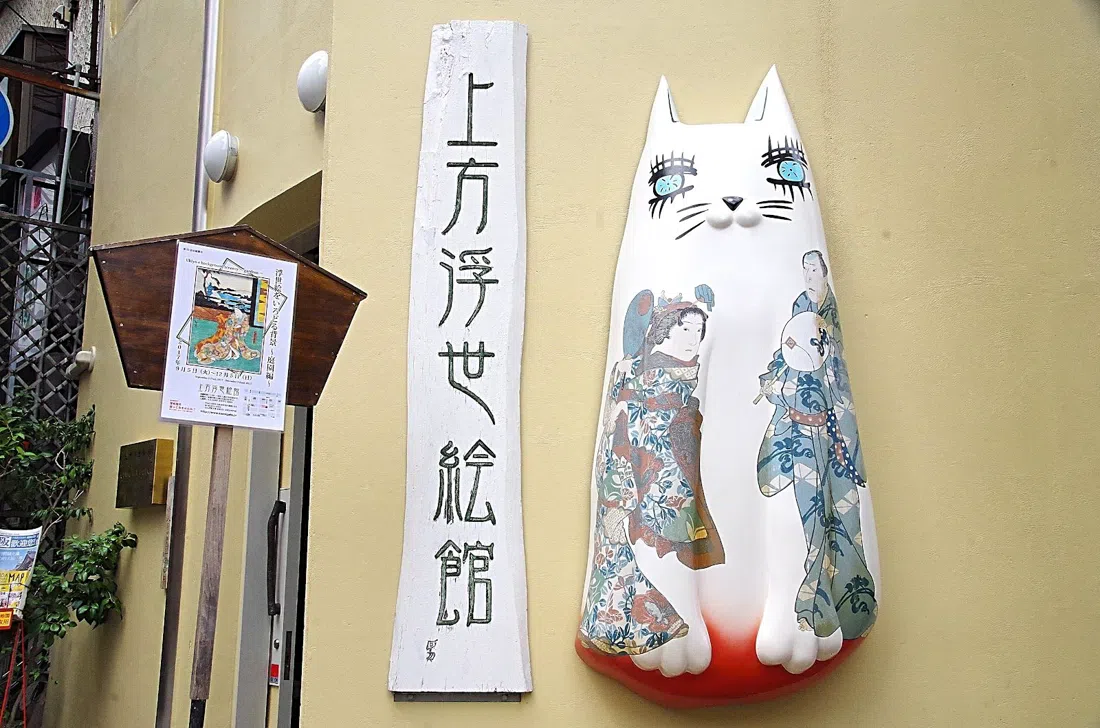
Kamigata Ukiyo-e Museum (near Hozenji Yokocho) is the only museum in the world devoted to Osaka-made kabuki actor prints. About thirty are on show at a time, rotated roughly quarterly. Entry is ¥700 for adults, ¥500 for high school students and ¥300 for younger children, open 11:00-18:00 with last entry at 17:30 and closed Mondays. The building is genuinely small, four or five people at a time, so a group has to split and stagger entry. Budget thirty minutes, not an afternoon, and you will have got the point of it.
Driving the route instead of walking it
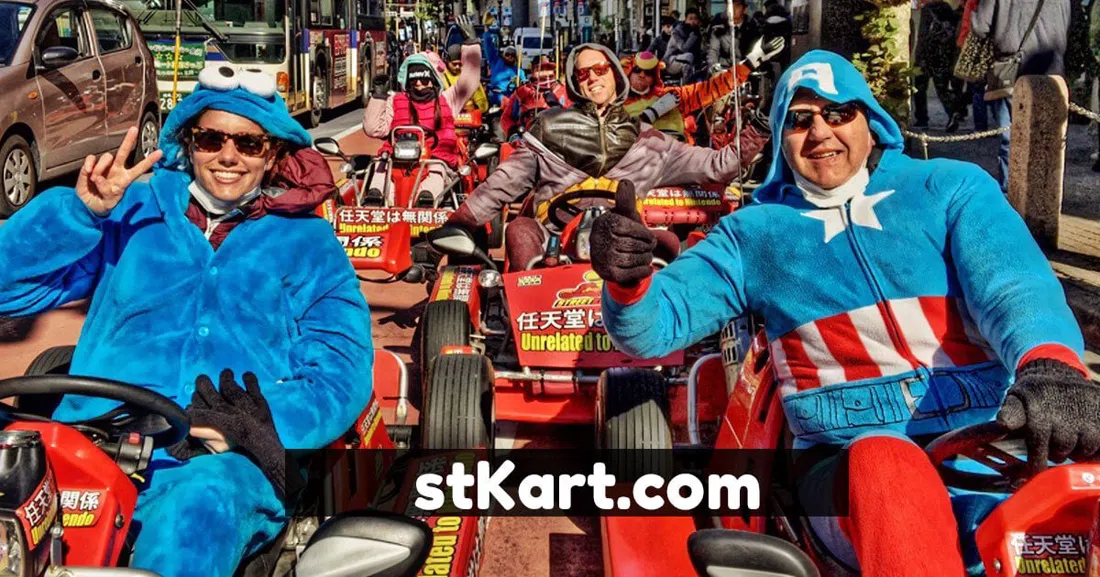
Street Kart Osaka (1-14-19 Minami-Horie, four minutes from Yotsubashi) runs go-kart convoys behind a lead guide on public roads, with a route that cuts through Shinsaibashi and Dotonbori. Slots run roughly 12:00-19:00 and cost ¥7,000-12,000 per driver depending on the time. It is built for groups and it is the only item on this list that has a hard legal gate: every single driver needs a valid Japanese licence or a 1949-Convention International Driving Permit in physical booklet form. A digital copy, a translation app or a permit issued under a different convention will not do. Turn up without the booklet and you are refused, with no refund.
Turning up on the day versus booking ahead
Almost all of this is walk-up. The arcade, the boulevard, Amerikamura, BIG STEP, Hozenji and the Ebisubashi view cost nothing and require no planning at all. The river cruise, the ferris wheel and the museum are door-ticket purchases where the only real risk is arriving at the wrong hour rather than finding them full. The things that genuinely need reserving in advance are the rooftop bar, the karts, and the alley restaurants.
A guided option exists if you would rather have the district explained than decode it yourself, and it is well-used: there are 5,996 traveller reviews across the bookable tours here, the top-rated one carrying 4.9 out of 5 from 1,851 reviews. Those tours run seven days a week, Monday through Sunday, and start from 42 USD per person. That is the honest trade: you are paying for someone to make the timing and routing decisions this article has just made for you, plus context you would not get from signage.
Best time to go
Mornings belong to the arcade. From opening until about 11:00 you can walk it at your own speed, the Daimaru tax-free counter is not queued, and Kuromon still has its seafood. This is the window where Shinsaibashi feels like a working street rather than an attraction.
Midday to about 16:00 is the weakest stretch. The arcade fills, the department store counters back up and the market thins out. Use it for the indoor, capacity-tolerant things: BIG STEP's basement, the PARCO character floors, the thirty minutes at the ukiyo-e museum. Or leave the district entirely for Orange Street, where the crowd never really arrives.
From 17:00 the balance tips again. The crush peaks around 18:00, so this is when Midosuji earns its place in the plan. After about 19:00 the Hozenji lanterns are lit and the alley looks the way people remember it; after about 20:00 the Glico sign is photographable from the north bank without a wall of people in front of it. The river cruise runs until 21:00, and the last couple of departures are the best ones.
Weekends are heavier throughout, and holiday weekends heavier still. Rain barely matters here. The arcade is covered, BIG STEP and the malls are indoors, and only the karts and the open-boat cruise care about the weather. Tuesday is the one day with a structural quirk: the ferris wheel does not start until 13:00 because of maintenance.
Is it worth it
Yes, with one honest caveat: Shinsaibashi is not a sight, it is a place to spend time. If you arrive expecting a single defining view you will take the Glico photo in four minutes and wonder what the fuss is. If you arrive with a day and a willingness to step off the covered street every few blocks, it is the most complete concentration of contemporary Osaka you can walk on foot: heritage architecture, a 1933 interior, capsule machines, a tiny print museum, a canal, a two-metre lantern alley and a food market, all inside about twenty-five minutes of walking.
It suits shoppers, first-time visitors who want the district that explains the city, families with teenagers, and anyone travelling in rainy weather. It suits couples best in the evening, when the alley and the rooftop come into their own. Large groups can absolutely do it, but only with the splits flagged above, because the arcade itself, the vintage shops, the alley and the rooftop bar all punish a party of twelve. Skip it if crowds genuinely ruin your day and you are only in town midweek at peak hours; go early instead, or not at all.
Practical notes
Getting there. Shinsaibashi Station sits under the north end of the arcade, and the south end delivers you into Dotonbori and Namba on foot. Yotsubashi is the closest station to Orange Street and the kart shop, four minutes away. You will not need transport within the district at any point. The entire route in this article is walkable end to end, and the longest single leg is the twelve minutes east to Kuromon.
Cash. Carry some. The ferris wheel booth is cash only at ¥1,000, market stalls and small vintage shops often are too, and gachapon machines want ¥300-600 in coins. The department stores, malls and the cruise take cards without issue.
Timing. Give it a full day if you want the whole route, or split it: arcade and Kuromon in the morning, Orange Street or Amerikamura in the dead midday hours, Dotonbori and Hozenji from 19:00. Museum closes Mondays; the wheel starts late on Tuesdays; the rooftop bar's hours are still settling.
Budget. A day of walking here can cost nothing at all beyond food. Add the cruise at ¥2,000, the wheel at ¥1,000 and the museum at ¥700 and you are at ¥3,700 for the paid attractions combined. Eating is where it varies: ¥500-800 for takoyaki in Amerikamura, ¥800-2,500 in the PARCO basement, ¥3,000-8,000 a head in a Hozenji alley restaurant. The karts are the one genuinely expensive item at ¥7,000-12,000 per driver.
Staying nearby. Sleeping inside this area (north Shinsaibashi near the boulevard, or east towards Kuromon) is what makes the early-morning and late-evening windows usable, because both depend on being five minutes away rather than a train ride. Compare rates and locations on the Osaka hotel search, and read the wider Osaka guide if you are building the rest of the trip around this district.